

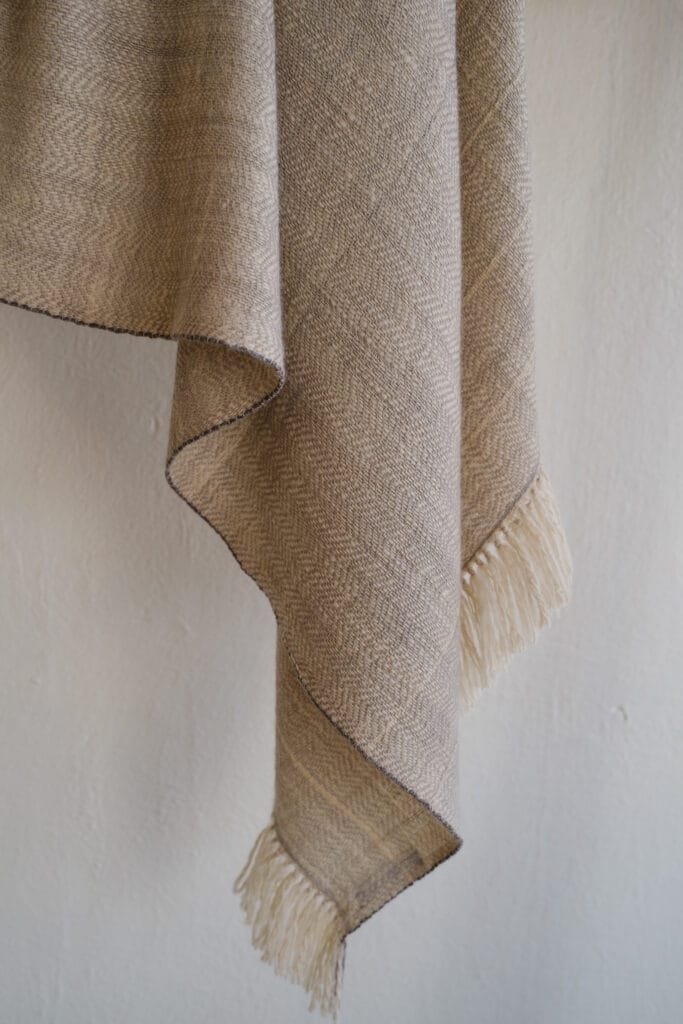
Luxury often comes with a price tag. A fancy label, expensive materials or a known name can make a shawl seem luxurious before you even hold it.
When you actually wear one, the feeling is different. You may find that luxury isn’t about cost at all.
Pick up a made shawl, and you might notice something simple. It feels soft in your hands. It sits naturally on your shoulders. It keeps you warm without being too thick. The surface has texture—something instead of flat and perfect.
A pure Pashmina shawl can have these qualities. Pashmina alone doesn’t make everything luxurious. The fibre matters. So do the yarn, the weaving, the dyeing and the finishing.
Sometimes the true luxury lies in details you don’t see at first glance.
It Starts With the Fibre
The material plays a role in how a shawl feels.
Pashmina is known for its fibres and lightness. Sheep wool usually has body and makes a shawl feel stronger. Yak wool offers warmth and texture. Alpaca is famous for being soft and smooth.
None of these fibres needs to pretend to be something
A real Pashmina shawl feels different from a woollen one. You feel that difference when you lift it, fold it, or drape it over your shoulders.
That difference comes from the fibre itself.
Lightness Can Feel Luxurious
There’s something satisfying about a shawl that does not feel heavy but still keeps you warm on a day.
This is why Pashmina has been valued for a long time. Its fine fibres allow the fabric to trap heat without needing to be thick.
People often think that heavier shawls must be warmer or better.
Not always.
Weight, thickness and warmth are connected. Not the same thing. A lightweight shawl can keep you comfortable in certain weather. A thicker woollen shawl might be better when the cold really sets in.
The right choice depends on the fibre. How the fabric was made.
Then There Is the Drape
This is something you notice when a shawl is worn.
Some fabrics stay stiff. Others fall gracefully around the body.
A handwoven shawl can have beautiful drape because of how the yarn and weave work together. It doesn’t have to be perfectly smooth or completely uniform to look good.
In fact a little movement in the fabric can make it more interesting.
This is especially noticeable with fibres. A pure Pashmina shawl folds easily and fits close to the body. Changes shape depending on how you wear it.
That’s part of what makes it appealing.
Hand-Spun Yarn Has Its Character
Machine-made yarn is very consistent. Every strand behaves the same way.
Hand-spun yarn is different.
There can be variations in thickness and texture. When that yarn is woven by hand, those differences become part of the product.
You might feel a change as your hand moves across the fabric. The surface may not look the same from one end to the other.
For a shawl that isn’t a flaw.
It’s proof of the process.
Natural Colour Doesn’t Always Look Flat
Colour can change the personality of a shawl.
A dyed textile can have subtle shifts that add depth. Even in one uniform shade, there might be small differences in how the colour shows up across the weave.
Natural dyes also connect the item to traditional crafts.
For someone buying a Pashmina shawl or another handwoven piece, this is an important part of the experience. You aren’t just choosing a colour. You’re choosing how that colour works with the fibre and the weave.
Perfect Isn’t Always Better
Walk into a shop selling mass-produced textiles. You’ll see rows of shawls that look nearly identical.
That kind of consistency has its place.
Handmade textiles follow a path.
Small variations in size, weave, texture or colour can happen when artisans use fibres and traditional methods. Two shawls from the collection might still have tiny differences.
That’s one reason handmade pieces feel special.
You can look at a Pashmina shawl. Notice it doesn’t have the perfectly uniform look of a factory-made fabric. Instead of seeing that as a mistake, you can understand it as part of its handmade character.
Luxury Is Also About How You Use It
A beautiful shawl that stays in your cupboard isn’t useful.
Think about how you dress.
Maybe you want something enough to carry while travelling. Maybe you need a wrap for winter evenings. Perhaps you want a shawl that goes well with a casual kurta one day and a formal outfit the next.
These things matter when choosing between Pashmina, wool, yak or alpaca.
A woollen shawl may be the choice for colder days. A Pashmina shawl may suit someone who wants something finer. Yak wool appeals to people who enjoy natural textures. Alpaca offers softness and smoothness.
Luxury isn’t about picking the expensive-looking option.
It’s about finding something that feels right when you wear it.
The Craft Is Part of the Luxury
The more you examine a handmade shawl, the more you realise the fibre is only the beginning.
Someone had to prepare the fibre, spin the yarn, choose the colours, set up the loom, and work the fabric. Each step affects what you finally feel in your hands.
This is especially true with fibres.
A pure Pashmina shawl is valuable not just because the word “Pashmina” sounds luxurious. Its appeal comes from natural fibre, skilled craftsmanship and the character that develops through the making process.
The same applies to wool, yak and alpaca.
The fibre tells you where the shawl begins. The craft helps determine what it becomes.
So What Really Makes a Shawl Luxurious?
It could be the softness.
It could be the lightness.
It could be the way the fabric falls around your shoulders or the warmth you feel without needing a layer.
For someone, it might be the uneven texture of hand-spun yarn or the subtle colour variation from natural dyes.
Sometimes it is simply the feeling that you are wearing something made slowly, thoughtfully, and by hand.
That is why luxury, in a shawl, cannot always be measured by price or appearance.
A special shawl is one you notice the first time you touch it—and continue to appreciate every time you wear it.
