

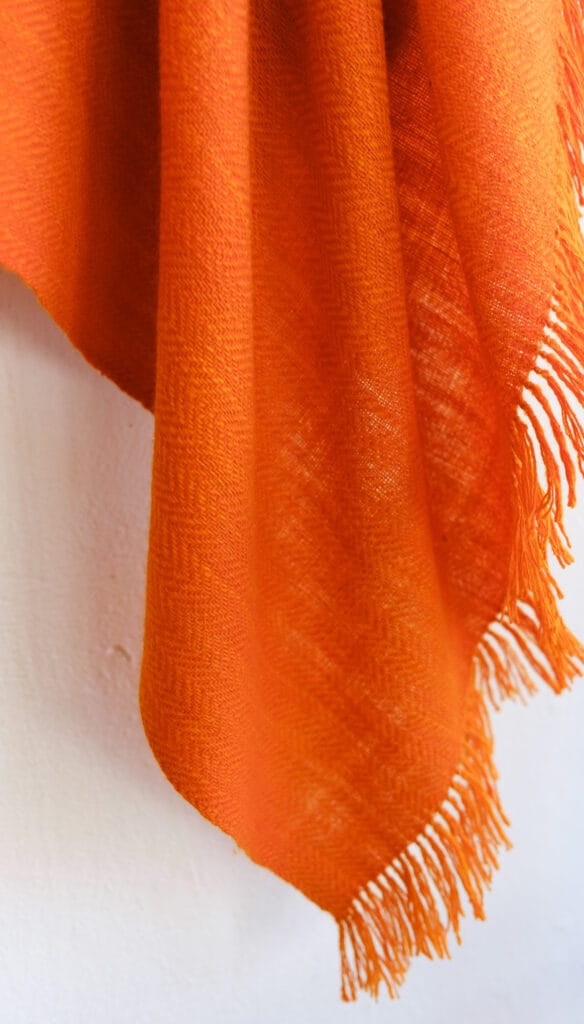
When you say ” Himalayan textiles “, most people think of Pashmina. Why not? It’s earned the reputation. Soft, light and warm enough to handle winter without adding any weight. Pashmina is not the only fibre worth knowing about in these high mountains.
Sheep wool, yak wool, alpaca. Each one has its character. Some feel tough and simple. Others are surprisingly soft. The colours vary too. Yak wool often comes in earthy tones straight from the animal. Alpaca, on the other hand, takes dye like a sponge. It’s clear that when you stand in a shop choosing between a Pashmina shawl, a wool one or something made from yak or alpaca, there’s a lot more than meets the eye.
It all comes down to the fibre.
Pashmina
Pashmina is the undercoat of Himalayan goats that live at high altitudes. Ladakh is the most common name you’ll hear. The fibre is much thinner than wool, and that’s exactly what makes it special. A made Pashmina shawl can sit on your shoulders with almost no weight and still keep you warm.
There’s a feel to a Pashmina that you can’t ignore. It’s not just soft. When the yarn is hand-spun, you’ll notice imperfections in the texture. These tiny variations are what give the shawl its soul. Machine-made fabric is too uniform. It lacks character. If you want warmth without bulk, Pashmina is usually the go-to choice.
Sheep Wool
Wool is the one most people already know. Himalayan communities have used it for generations. Sheep do well in this kind of terrain, so it makes sense that wool’s a staple. It’s. Woven into shawls, stoles, blankets. The kinds of things you use every day.
Compared to Pashmina, sheep wool feels heavier. It has body, and that’s the point. That weight is what makes a woolen shawl truly effective when the cold bites. Hand-spun and handwoven wool has a natural texture. It feels real. It feels made. It doesn’t feel mass-produced.
Yak Wool
Yaks are as Himalayan as it gets, so it’s natural that their wool has its place. The soft undercoat is collected by hand during months when the animals shed it naturally. The fine fibres are separated, spun and woven into cloth.
The feel is different from Pashmina. Breathable and built to last. What I love about yak wool is the colour. It often comes in blacks, browns and greys right from the animal. That means a lot of it doesn’t need dye at all. If you like textiles that feel connected to their origin, yak wool brings that sense of place.
Alpaca
Alpaca is the one exception here. It’s not from the Himalayas at all. It comes from South America, where it’s been raised for centuries. So why does it appear alongside the others? Because it performs beautifully in cloth and offers something no other fibre quite does.
It’s warm, smooth and drapes well once woven into a shawl or stole. If you want a cosy feel without that woolly texture, alpaca is a great choice. It also takes dyes very well, which is why many artisans who use traditional methods love it.
So which one wins?
None of them really. And that’s not an excuse. Pashmina gives you softness, lightness and warmth. Sheep wool is the workhorse for thick winter wear. Yak brings warmth, natural colour and a touch of mountain spirit. Alpaca offers softness, smoothness and easy drape.
People love to rank these fibres as if one has to be on top. You’re comparing four materials built for different purposes. The better question isn’t which is best. It’s what kind of shawl do you actually want?
Why the weaving matters as much as the fibre
Here’s what often gets missed: the fibre is only half the story. Take two shawls made from the material. They can feel completely different based on how the yarn was spun and how it was woven.
Handweaving allows the fibre to keep its character. Small changes in yarn thickness, weave pattern, and texture aren’t flaws. They’re what make the piece unique. Add dyes, and you get another layer. A depth and variation in colour you don’t find in perfectly even machine-dyed cloth. That’s why a handwoven piece feels so different from something made in quantities.
Picking yours
Start by thinking about how you’ll use it. Want something light that still keeps you warm? Pashmina. Need a practical winter shawl you’ll wear all the time? Sheep wool. Drawn to tones and a fibre with a story? Yak. Care most about softness and a drape? Alpaca.
There’s no rule that says you must pick the one labelled luxurious. The right shawl is the one that feels right. The one whose weight, texture and warmth fit you. That’s the beauty of Himalayan textiles. It was never one fibre. Pashmina, wool, yak, alpaca. Four stories, and you can feel the difference the moment you put one on.
