

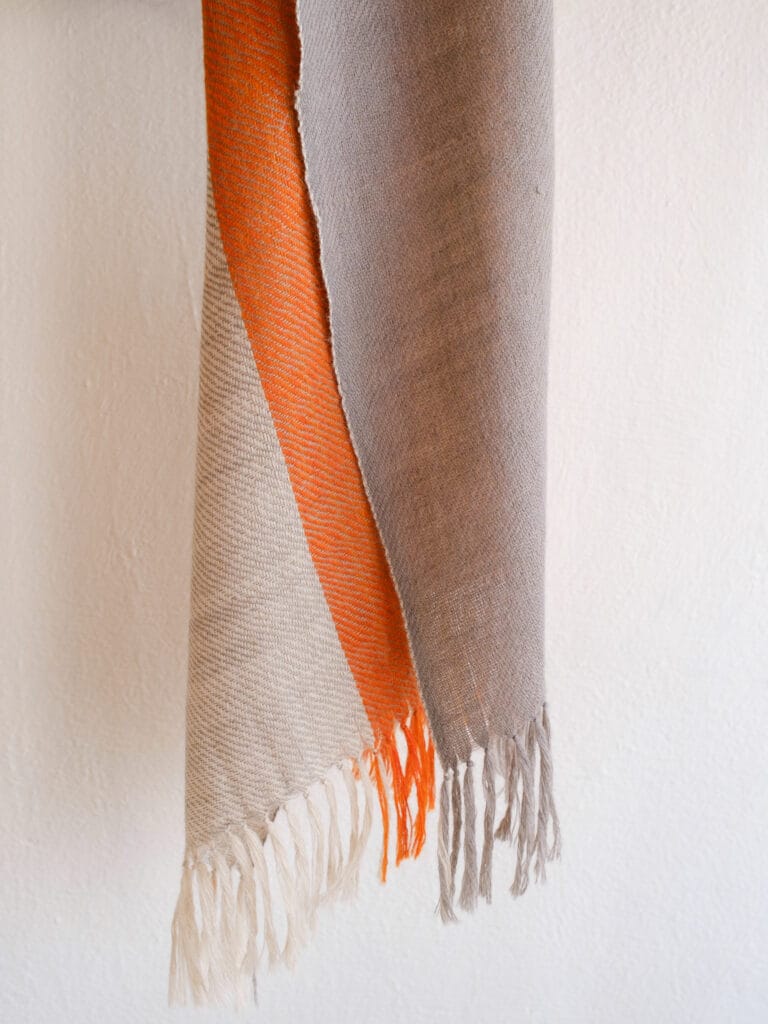
Say “Himalayan textiles” and most people think Pashmina straight away. Fair enough. It’s soft, it’s warm, and a good Pashmina shawl barely registers when you pick it up. But it’s not the only fibre up here. A few others have kept people warm for generations, and every one of them does its own thing on the loom.
Sheep and yaks? Been around forever. The Pashmina goats live even higher, out in the kind of cold that most animals just can’t take. Alpaca’s the outsider — doesn’t come from these mountains at all. Still, any of the four can end up as a shawl or a scarf, and trust me, the results are nothing alike.
Himalayan Weavers works with all of them by hand, using methods that go back a long way. A lot of the pieces get their colour from natural dyes, not chemical ones.
Pashmina: The Fine Fibre of Ladakh
It comes from the soft undercoat of goats that live way up in the cold. In India, that’s Ladakh, and the Changthang region especially — that place and Pashmina go together.
The goats grow this fine inner coat over winter to survive the plateau, which is genuinely brutal. Come spring, the fibre gets collected and readied for spinning.
Why’s it special? It’s just really fine — much finer than your everyday sheep wool. So a Pashmina shawl keeps you warm and still weighs next to nothing. It’s soft too, which is why it works so well for scarves and stoles.
Himalayan Weavers gets its Pashmina from Ladakh and does the spinning and weaving by hand, all of it.
It’s slow work, and that slowness is part of the point. A handmade Pashmina simply isn’t the same thing as something churned out by a factory. The raw fibre is only the starting point — it still has to be cleaned, spun, dyed and woven before a shawl exists at all.
Sheep Wool: A Familiar Himalayan Fibre
Compared to Pashmina, sheep wool is everywhere — and it’s been here a very long time. Sheep manage in all kinds of mountain conditions, and their wool has clothed families across the region for centuries.
In the cold, it just does the job. It’s warmer and more substantial than the really fine fibres, and it takes daily wear that delicate cloth simply can’t.
A few of the Himalayan Weavers’ pieces mix Himalayan and Merino wool. Some of it is still hand-spun by traditional communities before it hits the loom.
Pick up a woollen shawl after handling Pashmina, and the contrast is immediate. Wool has body. It has texture. And honestly, for pulling on through a long winter, plenty of people prefer that heavier, more reassuring feel.
There’s history woven into it as well. Wool was never just about making something nice to wear — in these mountains it was a survival resource, the difference between warm and cold when warm clothing wasn’t optional.
Yak Wool From the High Mountains
Yaks live at the very top of the Himalayas and Tibet. Cold that would finish off most animals? They barely notice it.
Beneath that shaggy outer coat there’s a softer down layer, and that’s the bit that goes into cloth.
It comes out warm and soft, with its own thing going on — not sheep wool, not Pashmina, somewhere of its own. Himalayan Weavers gets its yak fibre from Ladakh and Kinnaur, and makes shawls, stoles, and scarves out of it.
Here’s a nice bit: yak fibre is usually a natural dark brown, so cannot be dyed. The animal’s colour just becomes the cloth’s colour.
That’s a lot of the charm, honestly. The tone stays natural and pretty muted, and the piece holds onto this quiet link to the animal and the high ground it came from.
Alpaca: A Fibre From Much Further Away
Alpaca’s the odd one out. These animals are from South America, not here, so they don’t carry the same deep roots as sheep, yak, and Pashmina.
The fibre, though — it takes to handweaving really well. Soft, with a texture unlike the rest, and it makes lovely shawls.
Himalayan Weavers also makes handwoven Alpaca pieces, all dyed with natural colours.
Want something that isn’t Pashmina and isn’t plain old wool? Alpaca’s a good third option — a whole different feel, same patient hand-work behind it.
Four Fibres, Four Different Qualities
People love setting these fibres against each other, but that misses the point. They’re not really rivals.
Pashmina’s fine and light. Sheep wool’s practical and warm. Yak wool takes on serious cold and brings that natural colour. Alpaca’s got its own softness. Different jobs, basically.
The gap really shows once the fibre turns into cloth. A featherlight Pashmina stole and a woollen shawl are worlds apart, and a yak wool piece has a weight and look you won’t confuse with either.
And then the yarn matters. How it’s spun changes how it runs across the loom and how the finished cloth feels on you. The weaving piles on top of that again.
Which is the reason the name on the label doesn’t tell you much.
Handweaving and Natural Dyes
Everything at Himalayan Weavers becomes cloth by hand. The craft leans on skills handed down through weaving communities, tweaked to suit whatever fibre’s on the loom that day.
Natural dyes, too. The workshop works with madder, indigo, shellac, tea, harada, and tesu flowers to build its colours.
Since these come from natural stuff, no two pieces land exactly the same — the shade drifts a little from one to the next. Opposite of that flat, identical colour you get off a factory line.
And the work kicks off way before anyone sits at the loom. Fibre gets prepped and spun into yarn first. Dyeing and finishing only come in once the cloth’s actually woven.
Every one of those steps leaves a mark on the final piece.
Which Fibre Should You Choose?
There’s no clean answer — it comes down to what you actually want.
After something fine and barely-there? Pashmina, without question. It shines when you want warmth without lugging around a thick shawl.
For steady winter wear, sheep wool is hard to beat. Warm, versatile, and reassuringly familiar.
When warmth is the whole point, look at yak wool. That natural brown also gives it a look you won’t find among the usual dyed woollens.
And Alpaca is its own thing again — soft, comfortable, with a texture that sits somewhere outside both wool and Pashmina.
The Story Behind a Himalayan Textile
A shawl folded on a shop shelf kind of asks you to judge it on colour or pattern alone. But by then the fibre’s already travelled a long way.
Pashmina starts with goats up in the Ladakh highlands. Sheep wool comes off flocks tied to Himalayan life for generations. Yak fibre comes from animals built for the roughest ground you can imagine. And Alpaca, foreign as it is, throws its own qualities into the handwoven mix.
From there it’s prepared, spun, woven — and coloured with natural dyes before the scarf or shawl is done.
That mix of material, skill, and time is what gives handmade textiles from Himalayan Weavers their character.
So next time you’re picking a shawl, look past the word Pashmina. Sheep wool, yak wool, and Alpaca all bring something of their own, and the right one comes down to the feel, the warmth, and the look you’re after.
The fibre tells you where the cloth begins. The weaving — and the people behind it — tell you how the story keeps going.
