

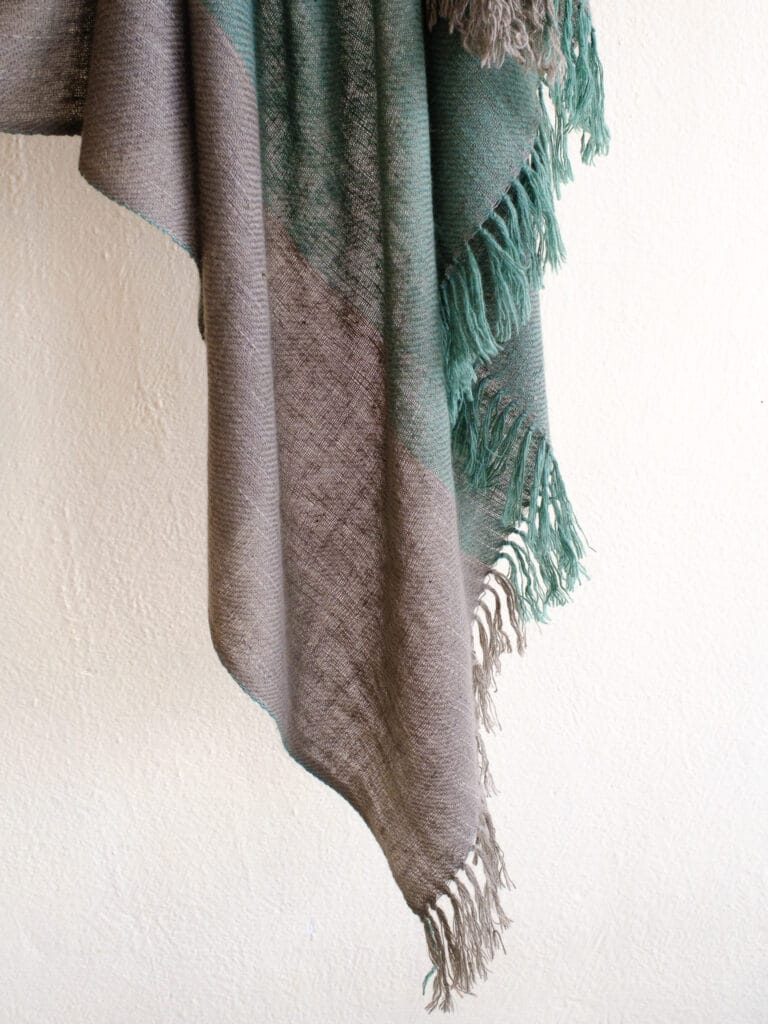
A Pashmina shawl can look beautiful at first glance. The fabric feels soft, the colours are attractive, and the word Pashmina on the label sounds reassuring.
But if you are spending money on a good shawl, appearance alone is not enough.
There is a big difference between knowing that a shawl is soft and knowing what it is actually made of. The fibre, where it comes from, how the yarn is prepared, and how the finished fabric is woven all tell you something about the piece.
This is especially worth considering when you are looking for a real Pashmina shawl or a pure Pashmina shawl.
Pashmina from India is traditionally associated with the high-altitude regions of Ladakh. In particular, the Changthang area is known for its fine Pashmina fibre. Himalayan Weavers sources Pashmina from Ladakh and works with a cooperative of nomads for its Pashmina products.
So, before buying a shawl, what should you actually look at?
Start With the Fibre
First, check the material itself.
Pashmina is the fine undercoat fibre of goats that live in cold, high-altitude areas. The animals grow this soft layer beneath their coarser outer hair to protect against severe winter temperatures.
In India, much of the Pashmina used for traditional products comes from Ladakh’s Changthang region.
This is why the word Pashmina should not be treated simply as another name for a very soft shawl.
When shopping, look for clear information about the material. A seller should be able to tell you what the shawl is made from rather than relying on vague descriptions such as luxury wool or cashmere feel.
If purity matters to you, certification is even more useful.
Himalayan Weavers has Pashmina shawls certified as pure Pashmina by the Pashmina Certification Centre of the Wildlife Institute of India, Government of India.
Where Does the Pashmina Come From?
The fibre’s source is another useful detail.
Pashmina is associated with several high-altitude regions, but Ladakh has a particularly important place in India’s Pashmina tradition. The Changthang region is home to pastoral communities who rear Pashmina goats.
For a buyer, knowing the source provides context. It also allows you to ask better questions.
Where was the fibre purchased?
Was it bought through a cooperative?
Was it processed locally?
Who spun the yarn?
Who wove the shawl?
These questions may sound simple, but they can tell you much more than a photograph ever will.
Himalayan Weavers purchases Pashmina directly from a cooperative of nomads in Ladakh rather than relying solely on private traders.
Hand Spun and Mill Spun Pashmina Are Not the Same
This is one detail that many buyers overlook.
Once the raw fibre has been prepared, it needs to be turned into yarn. They can do this by hand or by machine.
Traditional Pashmina spinning uses a charkha, or spinning wheel. Hand spinning is slow and requires a skilled spinner to work with the delicate fibre.
Himalayan Weavers uses hand-spun Pashmina yarn prepared by women in Rajpur, near Dehradun in the Garhwal Himalayas. The organisation also notes that mill-spun yarn has become much more common because it lowers production costs and speeds up manufacturing.
This doesn’t mean every mill-spun Pashmina product is automatically bad. The important point is to understand what you are buying.
If craftsmanship and traditional production are part of the reason you want a Pashmina shawl, hand spinning is certainly something worth asking about.
Look at the Weaving
The yarn is only one part of the finished shawl.
The way that yarn is woven also makes a difference.
A handwoven Pashmina shawl is produced on a loom rather than coming straight from an automated textile production line. The process takes time, and the finished fabric may have small variations.
Some buyers may initially think these variations are imperfections. In a handmade textile, they can simply be part of the process.
Himalayan Weavers describes its Pashmina products as handwoven on traditional looms. Its handwoven products can have small variations in size or minor differences in weaving and dyeing.
That is one reason handmade textiles can feel different from highly uniform factory-made fabrics.
Do Not Use the Ring Test as Your Only Proof
The ring test is probably one of the most famous Pashmina tests found online.
The idea is that genuine Pashmina is so fine it should pass through a ring.
It sounds like a convenient shortcut, but it should not be treated as proof that a shawl is pure Pashmina.
A fabric’s thickness depends on more than just the fibre. Spinning, weaving and the construction of the finished piece can all affect how easily it passes through a ring.
So, if a seller tells you that it passed the ring test and therefore it is pure Pashmina, that is not enough information to make a confident purchase.
What About the Burn Test?
You may also come across advice suggesting that you burn a small thread from the shawl.
Natural animal fibres react differently from many synthetic fibres when exposed to heat, but this test cannot tell you whether a particular animal fibre is Pashmina.
Other animal fibres such as wool can give similar results.
There is also an obvious problem. You have to damage the textile to carry out the test.
For an expensive shawl, asking for reliable material information and certification makes much more sense than setting part of it on fire.
Pay Attention to the Dyeing
Colour is usually one of the first things we notice about a shawl, but the dyeing process can be interesting too.
Traditional Himalayan textiles have long used plant-based materials for colouring wool. Natural dyes can produce a surprisingly wide range of shades, depending on the material and the dyeing process.
Himalayan Weavers uses natural dyes including madder, indigo, shellac, tea, harada and tesu flowers. It hand-dyes its Pashmina yarn at its facility near Mussoorie in the Himalayas.
Natural dyeing alone does not prove that a shawl is genuine Pashmina. These are two separate things.
Purity tells you about the fibre.
Dyeing tells you how the colour was produced.
If you care about traditional or slower textile production, though, it’s worth knowing both.
Why Handwoven Pashmina Can Have Small Variations
When buying handmade textiles online, people sometimes expect the product to look exactly like a machine-made fabric.
That is not always realistic.
A handwoven shawl may have slight variations in dimensions. The weave may not look perfectly identical from one section to another. Natural dyes can also produce subtle variations.
These characteristics do not necessarily mean something has gone wrong.
Himalayan Weavers specifically mentions that its handwoven Pashmina shawls may have small variations in size and some inconsistencies in weaving and dyeing. The organisation describes these as part of the handmade product’s character.
For someone buying handmade Pashmina, that distinction is useful. You are not simply buying a piece of fabric. You are buying something that has passed through several manual processes.
Is a Higher Price a Sign of Real Pashmina?
Not necessarily.
Price alone cannot establish whether a shawl is genuine.
At the same time, extremely low prices should make you curious about what you are actually getting. A product made from carefully sourced Pashmina, hand-spun yarn dyed with natural dyes, and handwoven involves considerably more labour than a mass-produced imitation.
Rather than asking only why a shawl is expensive, look at what the price includes.
Consider the fibre, its origin, the spinning method, the weaving method, certification, dyeing and the people involved in making the product.
Once you know these details, comparing two Pashmina shawls becomes much easier.
A Simple Checklist Before Buying a Pashmina Shawl
If you don’t know much about textiles, you don’t need to become an expert before buying.
Just check the basics.
Material: Is the shawl made from pure Pashmina?
Origin: Is the fibre sourced from a known Pashmina-producing region?
Certification: Is the fibre independently certified?
Spinning: Is the yarn hand spun, or mill spun?
Weaving: Is the shawl handwoven or machine made?
Dyeing: Does the seller explain which dyes were used?
Seller: Can the seller explain where the fibre and finished shawl come from?
A transparent seller should not have a problem answering these questions.
Why the Making of a Pashmina Shawl Matters
It’s easy to miss something when shopping online. The finished shawl hides a lot of work.
Before you can wear it, the fibre must be collected, prepared, spun into yarn, dyed when required, and woven into fabric.
With a hand-spun and handwoven shawl, those stages involve individual artisans rather than one large automated production process.
At Himalayan Weavers, women in Rajpur hand-spin Pashmina sourced from Ladakh on a charkha, then hand-weave it. The organisation also works with Himalayan communities to support traditional handweaving and natural dyeing.
That craftsmanship is part of what gives a handmade Pashmina shawl its character.
Real Pashmina Shawl: What Should You Actually Look For?
No single magic trick can answer the question.
A genuine Pashmina shawl is better understood by looking at several things together: the fibre, its source, how the yarn was made, the weaving technique, and the evidence the seller provides.
A ring test cannot tell you all of that.
Neither can touching the fabric for five seconds.
If you are buying a pure Pashmina shawl, take a little time to find out its story. Ask where the fibre came from. Ask how it was spun. Find out whether it was handwoven. If purity is important, look for proper certification.
If you choose a handwoven piece, don’t be surprised by tiny variations. They can be a natural part of the handmade process.
A good Pashmina shawl is not valuable simply because it feels soft. Its value also lies in the fibre, the workmanship and the people involved in turning that fibre into something you can wear for years.
Frequently Asked Questions About Real Pashmina Shawls
How can I identify a real Pashmina shawl?
Start with the material information, source and certification. Don’t rely on a single home test, such as the ring test. A seller who can provide clear information about the fibre and its production gives you a much stronger basis for judging the product.
Is pure Pashmina from Ladakh genuine?
Ladakh’s Changthang region is an important source of Pashmina in India. Himalayan Weavers sources Pashmina from Ladakh, including through a cooperative of nomadic producers.
Does real Pashmina have to pass through a ring?
No. The ring test is not enough to establish that a shawl is made from pure Pashmina. The fabric construction can affect whether it passes the ring test.
Is hand-spun Pashmina better?
Hand-spun and mill-spun yarn are produced differently. Hand spinning takes more time and relies on traditional skill. If you value traditional craftsmanship, a hand-spun Pashmina shawl may be particularly appealing.
What makes a handwoven Pashmina shawl different?
Handweaving involves working with the yarn on a loom rather than producing the fabric entirely through automated machinery. Small variations in size or weaving can occur as part of the handmade process.
How should I care for a pure Pashmina shawl?
Follow the care instructions supplied with the product. For handmade Pashmina, handle it gently. Avoid unnecessary rubbing, wringing and exposure to hot water.
Where can I buy an authentic Pashmina shawl?
Look for a seller that clearly explains the fibre, source, production method and certification rather than relying only on the word Pashmina in the product name. Himalayan Weavers offers handwoven Pashmina products made with Pashmina sourced from Ladakh.
