

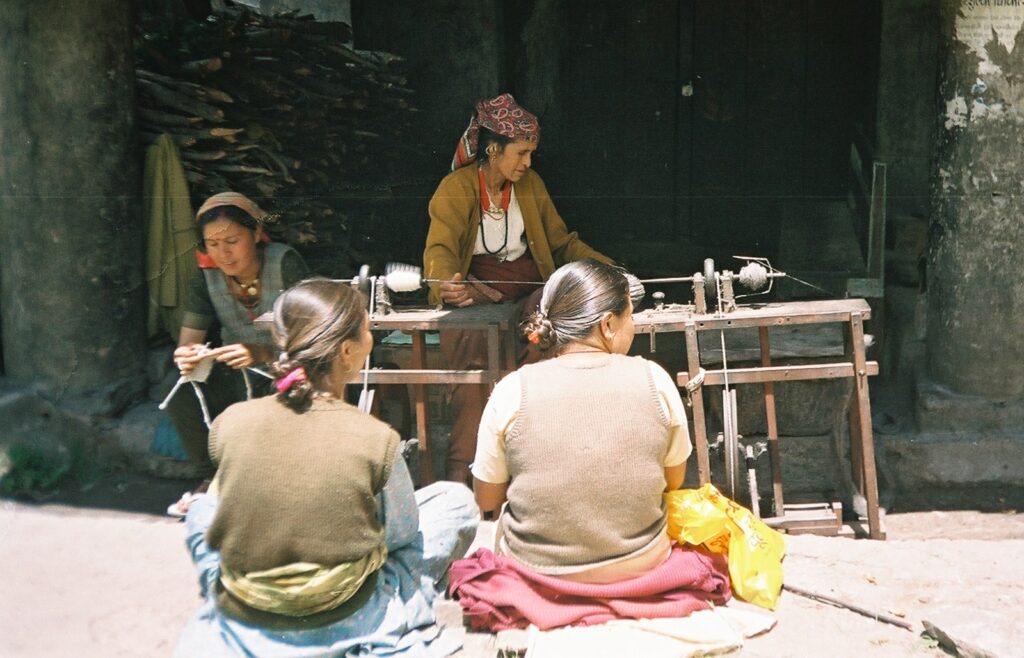
We started Himalayan Weavers—Ghayur Alam and Patricia Alam—in the early 2000s. We did not set out to build a business. It evolved gradually from the research work I (Ghayur Alam) was doing at the time, focused on the conservation of bio-resources in areas around Gangotri. One issue that concerned us was the illegal harvesting of medicinal plants from the Himalayan forests. These plants were in high demand, and their overharvesting was causing serious damage, with some species becoming threatened with extinction.
Bhotias- Traditional Weavers of Uttarakhand
During this work, we met some members of the Bhotia community in the Bagori and Dunda villages of Uttarkashi district. The Bhotias are traditionally a trading community. For generations, they traded with Tibet, and wool played an important role in their economy. When this trade stopped in the 1960s due to the Indo-China border conflict, they had to adapt. See: The Bhotias: the disruption in lifestyle of a nomadic community in the Indian central Himalayas by Subrat Sharma
One important way they did this was by focusing more on wool production and weaving. They mostly produced Handmade Woollen Shawls, scarves, and throws from coarse Himalayan wool. Both Bagori and Dunda are on the route to Gangotri, so they see a steady flow of pilgrims. This gave them a ready, though limited, market for handwoven woollen products among pilgrims and neighbouring villages.
As many of the Bhotia people were engaged in harvesting and trade of medicinal plants, we thought that if we could help them increase the range of their Handmade Woollen Shawls and Scarves (to make the products more acceptable to a wider, urban market), their incomes would increase, and this would reduce their dependence on forest products.
At that time, we knew nothing about wool or weaving. But soon we noticed two things. First, most of the wool used by the Bhotia people was undyed, in natural shades of white and grey. Earlier, they used natural dyes from local plants, but that practice had stopped. Second, the wool itself—produced from local sheep (Harsil Cross)—was quite coarse. This made it difficult to produce soft, high-quality woollen shawls and other products.
Sadly, our idea—to help revive natural dyes and upgrade their handwoven woollen shawls and other products—did not really work out. Since sheep rearing was an important livelihood for them, they were understandably not interested in switching to finer wool like merino. They preferred to use wool produced by their own sheep. Also, natural dyeing, which they had once practised, was now seen as too time-consuming. See: Indigenous knowledge of Bhotiya Tribal Community on Wool Dyeing and its Present Status in the Garhwal Himalaya, India, by Chandra Prakash Kala.
Setting Up of Himalayan Weavers
BY then, we had become quite interested in natural dyes ourselves. We looked for people who could teach us how to use these, but could not find anyone. So we decided to learn on our own. There was enough information available online to get started.
We began experimenting in our kitchen at our home in Masrana, near Mussoorie. We worked with small quantities of wool—we don’t even remember where we sourced the first batch from. We were fortunate that many of the materials used for natural dyeing (such as madder, tesu flowers and henna) are also used in Ayurveda and available in shops in Dehradun. Our early results gave us some decent reds and oranges, which were encouraging.
The next step was to find a weaver to weave the dyed wool. We were lucky. A weaver from Himachal Pradesh, Hari Chand, who had settled in Dhanolti (not far from us), was very helpful and wove two Handwoven Woollen Scarves for us. He also taught us the basics of weaving, which helped us understand how to think about design.
Patricia had earlier taught drama in the UK and Delhi, and had experience in designing costumes and sets for her theatre productions. She could use this experience in designing shawls and scarves. Slowly, we began to think that this could become something more than just an experiment.
From the beginning, we kept our focus clear: natural fibres, natural dyes, handwoven and handmade woollen shawls, stoles and scarves. Once we had a few pieces ready, we needed to sell them. Our home was on the road between Mussoorie and Dhanolti, both popular tourist destinations. So we set up a small shop in our veranda and put up a few signboards along the road. That was our first retail space.
Gori, who was already working with us, joined in, and Makhan Prasad helped us with dyeing. The setup was very basic—just a few metal pans and an old washing machine for rinsing and spinning the wool.
Slow Fashion-Making Natural Dyeing Sustainable
As we began dyeing larger quantities and mastered natural dyeing techniques, we also made the process more efficient. The most important improvement was the use of insulated drums, heated with electric blankets. This allowed us to reuse the dye bath several times, saving water and dye, and reducing waste. The insulation also reduced heat loss, so electricity use went down. Over time, the process became both more efficient and more environmentally friendly.
Selling, in a way, was the easier part. Himalayan Weavers’ products were different—made from natural fibres, natural dyes, and entirely handmade. There were not many comparable options in the market. Gradually, we started selling online as well. Later, we opened a shop in Rajpur, in Dehradun.
We also expanded our range to include pashmina and yak wool, and more recently, alpaca wool. Gori has matured into a very competent manager and looks after the Rajpur shop. Makhan Prasad has gained enough knowledge and experience to become a master dyer and is responsible for the colours from natural dyes that distinguish our products. Mohammed Furqan and Mohammed Hassan, both from traditional weaving families and master weavers, produce beautiful handwoven shawls, scarves, and stoles.
Organic Growth and Community Focused Enterprise
Looking back, this was not something we planned. It grew out of circumstances and our interest in working with local communities. Over time, it became a small but sustainable enterprise—one that supports artisans and continues to promote handmade, handwoven shawls, scarves, and stoles made from natural fibres and natural dyes.
Explore our collection of handmade, Handwoven Woollen Shawls, Stoles and Scarves.
