

We Ship Worldwide
Free Shipping Within India
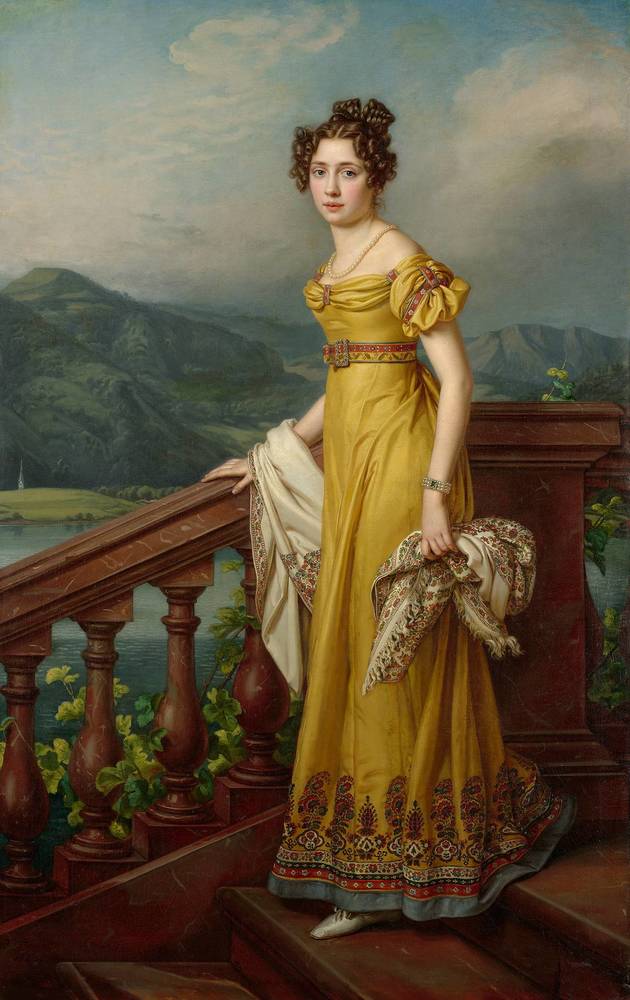
Pashmina Shawls introduced in Britain and Europe. Pashmina shawls were first introduced to the British through East India Company employees returning from India. Their incredible softness and beauty enchanted the aristocracy of Britain, France, and several other European countries.
But there was a problem: authentic, handmade pashmina shawls from Kashmir were expensive, and only a small elite could afford them.
This high demand but limited supply encouraged British weavers to attempt to produce imitation shawls at a lower price.
The earliest large-scale imitation shawls were produced in Norwich beginning in 1803. They were far cheaper than real pashmina, but their quality was poor, lacking both the fineness of fibre and the sophistication of Kashmiri craftsmanship.
About 25 years later, weaving innovations in Edinburgh produced shawls that looked much closer to Kashmiri originals. These versions were of better quality and sold well not only in Britain but also across Europe. However, despite their popularity, they still could not match the feel and elegance of genuine pashmina scarves and shawls.
A major breakthrough came in the 1830s when Paisley, a small Scottish town, adopted the Jacquard loom . This allowed weavers to create intricate designs similar to those on Kashmiri shawls.
For years afterward, Paisley dominated the global market for imitation shawls. But imitation could only go so far these shawls were made from regular wool, nowhere near as soft or fine as true pashmina.
The secret behind the unmatched luxury of handmade pashmina shawls lies in the fibre. Authentic pashmina comes from the Changthang plateau of Ladakh and Tibet, where high-altitude goats produce an exceptionally soft undercoat.
The British government and manufacturers quickly realised that without access to genuine pashmina fibre, they could never produce shawls as fine as those from Kashmir. This led to a determined effort by the British to access pashmina at its source.
One of the most fascinating figures in this story is William Moorcroft, a veterinary surgeon with the East India Company. Between 1812 and 1822, he travelled through Garhwal, Ladakh and Kashmir, gathering detailed information about:
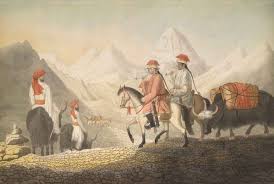
Moorcroft found that although pashmina shawls were woven in Kashmir, the fibre was produced in Tibet and Ladakh. Tibetan pashmina was sold only to Ladakhi traders, who then supplied Kashmiri merchants. The pashmina trade monopoly of ladakhi and Kashmiri traders was legalized by the Treaty of Tingmosgang (1684), signed between Tibet, Ladakh, and the Mughal Empire. The Treaty stated that:
Due to this trade monopoly, attempts by Moorcroft to buy pashmina and pashmina goats from Tibet were not very successful.
This monopoly survived political changes for centuries. Even after the Treaty of Amritsar (1846), British authorities could not break into the trade. Tibetan officials refused to deal directly with British merchants, insisting that all trade must pass through Ladakh.
So although the British exercised political control over the region, they remained dependent on Ladakhi and Kashmiri traders for access to Tibetan pashmina.
Frustrated by their lack of access, the British attempted other methods to capture part of the shawl market. They did this by Encouraging Shawl Production in British-Controlled Areas. They began promoting shawl-weaving activities to regions under direct British control. After annexing Punjab in 1849, they encouraged pashmina shawl weaving in Amritsar and Lahore. In order to improve the quality of shawls being woven in Lahore and Amritsar, they encouraded migration of Kashmiri Weavers. They provide support for setting up karkhanas (workshops). By the 1850s, thousands of skilled Kashmiri weavers had relocated to these cities. They further encouraged production by reducing customs duties on pashmina imported into British-controlled territories.
Amritsar soon became a major production centre, while Lahore developed as a finishing and export hub.
The Decline of Britain’s Interest in Handmade Pashmina Shawl Trade
Ironically, just as they successfully built these new weaving centres, Britain’s own enthusiasm for handmade pashmina shawls waned. The mass production of Paisley shawls cheaper and widely available flooded the market.
Over time, this industrial production ended up harming the very artisan industries the British had supported in India. The old, handwoven pashmina tradition suffered greatly, even as imitation shawls dominated European markets.
